Jungkook–BTS relationship
O fenômeno Jungkook: O sucesso do BTS e a criação de um superstar mundialJungkook–BTS relationship is the emotional and formative center of Jungkook’s career: the six older members did not merely perform beside him, but helped create the person and artist he became. Their bond links his adolescence in training and dormitory life to his later solo success, his devotion to fans, and his decision to enlist alongside the group rather than preserve the maximum possible time for himself. In the book’s account, Jungkook’s rise is inseparable from BTS, and his most consequential choices repeatedly place the group before individual advantage.
A Chosen Family Formed in Youth
Jungkook entered BTS as the youngest member, and the group became the environment in which he grew up. He spent his middle-school years training and living in a dormitory, then passed through high school as a full-time idol without the ordinary opportunities to attend school or socialize as a typical teenager. The six older members surrounded him constantly, influencing him through their habits, knowledge, personalities, and shared ambitions. Jungkook later described himself as a manifestation of all their personalities together, saying that the members had shaped him one by one.
This history gives the relationship a depth beyond ordinary band camaraderie. Jungkook has said that without BTS and the six members who practically raised him, there would be no Jungkook as the public knows him. The group therefore functions as a chosen family: a durable emotional community whose members’ identities have been formed through shared labor, dependence, and time. The book emphasizes that this collective structure also makes the group’s culture of supporting all seven members especially important. Jungkook’s humility and apparent discomfort with being singled out as the most likely solo star reflect his attachment to that collective rather than a desire to outrank it.
Mutual Care and Emotional Recognition
Jungkook’s relationship with the older members is marked by care that runs in both directions. During the BTS Wings Tour performance in Chile, he completed the show despite severe physical distress. Afterward, he staggered backstage, lay on a gym mat with his eyes closed, and was surrounded by doctors who placed oxygen over his mouth. SUGA secretly cried in the bathroom out of concern, while Jimin stayed beside Jungkook as an ice pack was placed on his forehead and oxygen cylinders were left nearby. When Jungkook recovered enough to return to the waiting room, the members were relieved and astonished that he had finished the concert.
Jungkook explained that he had performed while ill because he expected not to see the Chilean fans for a long time. His extreme professionalism thus connected his devotion to ARMY with the protective concern of the members around him. The scene shows the relationship operating as a practical system of mutual responsibility: Jungkook converts physical suffering into performance for the audience, while the other members attend to the body that the performance has strained.
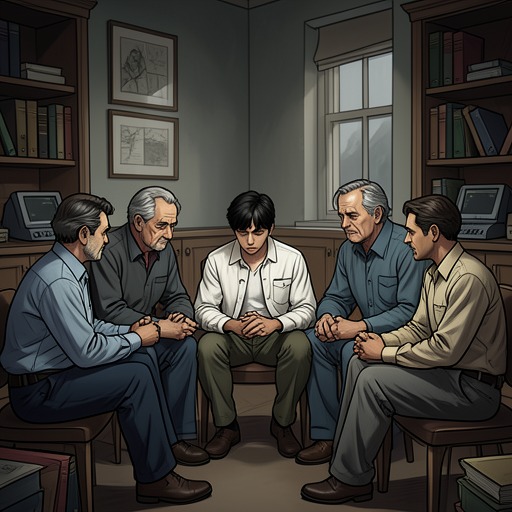
The most intimate evidence of the bond appears in the making of “Begin,” Jungkook’s solo song on Wings. At nineteen, he wanted to write his own lyrics but could not yet express his feelings in words, so RM helped capture his story. Around January 2016, all seven members gathered to cry, complain about their difficulties, and comfort one another. Jungkook, who normally did not cry or voice hardship and habitually assured the others that he was fine, wept openly for the first time in front of them. When asked what troubled him, he did not identify a personal grievance. What hurt him was seeing the six older members suffer.
That confession became the emotional basis of “Begin.” Rather than presenting the youngest member as an uncomplicated all-rounder whose future lay primarily in solo achievement, the song portrays his gratitude toward the people who took in a small, inexperienced boy without a settled identity and taught him how to feel. The relationship is therefore not only something Jungkook speaks about; it is material transformed into music, with RM acting as the collaborator who gives language to feelings Jungkook could not yet articulate himself.
The Group Before the Solo Career
When BTS announced Chapter 2 in 2022, each member was given an opportunity to pursue personal projects before military service interrupted their careers. Jungkook took nearly five months away from work, and then spent only about eight months undertaking solo activities. The book presents this period as a moment when he could plausibly have prioritized an independent international career. His voice, dancing, appearance, brand partnerships, and growing recognition had already made him a natural candidate for major solo success.
Even during those activities, however, Jungkook repeatedly described the absence of the members rather than celebrating separation from them. In an interview, he said that solo work made him miss the relaxed backstage moments when the members each did different things, and even made him want to attend SUGA’s show. He wanted to stand onstage with the other members as soon as possible. The longing is significant because it interrupts the usual narrative of the breakout youngest member finally escaping the group’s shadow. For Jungkook, solo visibility does not erase the group; it makes the group’s absence more noticeable.
His public statement in a November 2023 Weverse live made the hierarchy explicit: BTS mattered more to him than his solo work. The claim was not merely sentimental. After releasing Golden, Jungkook stood at a point where continuing alone could have maximized his individual momentum. Instead, he chose a course that preserved the possibility of seeing the complete group return as soon as possible. He described the decision as motivated by the wish to see BTS complete again and said that he did not regret it, but felt relieved that it had been made.
Loyalty and Military Enlistment
South Korean military service transforms the group’s relationship into a question of time, duty, and sacrifice. Men generally must serve before the age of twenty-eight, although the BTS Act allowed eligible cultural artists to defer enlistment until thirty. The policy itself acknowledged that forcing major pop artists away from their careers during their peak could damage both their careers and the nation’s cultural interests. Yet a complete exemption remained controversial because public perceptions of fairness were central to military service.
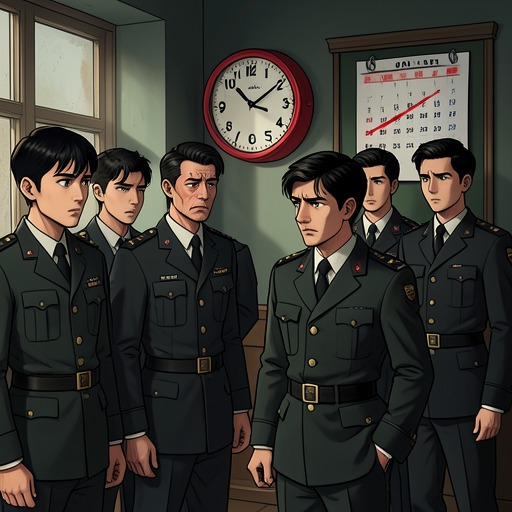
The members did not ask for exemption. Jin enlisted in December 2022, J-Hope in April 2023, and SUGA in September; RM followed in December. Jungkook, Jimin, and V still had years available under the ordinary timetable, but chose to enlist with the older members. This contradicted the usual K-pop strategy of staggered enlistment, which preserves a group’s public presence and allows releases to continue. Their collective decision instead prioritized an earlier return of all seven.
Jungkook’s choice was especially striking because he was the youngest and had just released his first solo album. He could have delayed enlistment and used the most commercially valuable years of his solo ascent to consolidate his global position. The book interprets his decision as loyalty not only to the country but to BTS. On the eve of enlistment, wearing a black cap over his shaved head, he acknowledged to fans that he was sad, even while describing military service as something all men had to do. The subdued admission exposed a private feeling beneath the expected public posture of patriotic acceptance.
On the morning of December 12, Jungkook made a final brief Weverse broadcast while doing laundry, with the sound of a dryer turning in the background. The ordinariness of the domestic setting made the separation more affecting: he treated the end of his idol life for a time as an everyday task rather than a spectacle. He said goodbye in formal Korean and English, repeated the farewell as though reluctant to end, and told the fans that he loved them. The farewell was directed to ARMY, but the larger decision behind it was directed toward the six older members with whom he had spent nearly his entire formative life.
The Relationship’s Lasting Meaning
The relationship between Jungkook and BTS is presented as a cycle of formation and repayment. The members gave Jungkook a home, an education in artistry, and the personalities through which he learned to understand himself. Jungkook repaid them through disciplined work, emotional loyalty, concern for their suffering, and a willingness to sacrifice individual timing for the group’s reunion. His devotion to fans is inseparable from this structure: BTS and ARMY remain the two pillars he carries with him even when he is working alone.
That devotion also helps explain why the group endured despite pressures that might otherwise have encouraged separation. Industry observers speculated that HYBE’s insistence on equality kept BTS together, but the book contrasts that cynical interpretation with the members’ repeated gestures of support, pride, and affection over a decade. The evidence offered by Jungkook’s tears, his songs, his backstage longing, and his enlistment decision suggests that institutional management alone cannot account for the group’s cohesion.
The relationship’s central word is devotion. It describes the members’ care for the youngest among them, Jungkook’s dedication to the craft they taught him, and his willingness to let the group’s future outrank the immediate rewards of solo stardom. His transformation from a hardworking boy from Busan into an international pop star is therefore not framed as an escape from BTS. It is the outcome of a bond that made his ascent possible and continues to define what that ascent means.